What if we already know a great deal about how to provide high-quality conservative care for people with knee and hip osteoarthritis, but that knowledge does not consistently reach everyday clinical practice?
Evidence-based guidelines provide clear recommendations for conservative knee and hip osteoarthritis (KHOA) care. Yet, many patients still do not receive these recommended treatments. The challenge is therefore not only knowing what works, but ensuring that this knowledge is translated into daily healthcare practice.
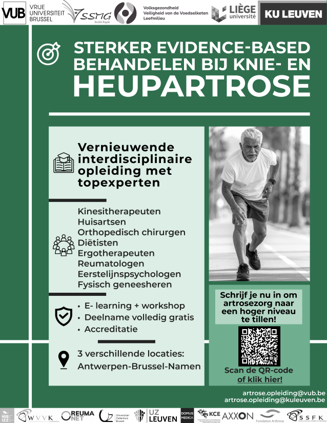
This challenge is at the heart of the project I presented at the Pain Science in Motion (PSIM) Congress 2026 in Brussels. Our aim is to develop, implement and evaluate a training program that supports healthcare providers in delivering evidence-based conservative KHOA care across Belgium.
From knowing to doing
We aim to train approximately 600 healthcare providers, primarily general practitioners and physiotherapists. The training focuses on patient education, tailored exercise, preoperative management and appropriate referral. It also promotes a biopsychosocial understanding of pain, integrates contemporary pain science into clinical reasoning, supports patient-centred management and encourages effective interdisciplinary collaboration.
The program uses a blended learning approach, combining e-learning with interactive face-to-face workshops. It includes an interdisciplinary training as well as an additional physiotherapy-specific training, allowing us to address both shared and profession-specific learning needs.
Rather than simply transferring information, the training aims to help healthcare providers apply evidence in realistic clinical situations. Interactive discussions and case-based learning therefore form an important part of the face-to-face workshops.
Does training translate into change?
Developing the training is only one part of the project. We also want to understand its impact and how successfully it can be implemented.
Using a type 1 hybrid effectiveness-implementation design, we evaluate changes in healthcare providers’ knowledge and attitudes alongside implementation outcomes such as barriers, quality, acceptability, satisfaction and usability. Participants are assessed before the training, immediately after the workshops and again at six months, allowing us to explore whether changes are maintained after participants have had time to apply the training in practice. Two focus groups will provide further insight into barriers and facilitators to implementation.
The project is currently ongoing, and registration for the training program is still open. Healthcare providers interested in strengthening their evidence-based approach to conservative KHOA care can sign up to participate.
By supporting healthcare providers in applying evidence-based recommendations, we hope to contribute to high-quality, patient-centred conservative care for people with knee and hip osteoarthritis.
Because ultimately, high-quality osteoarthritis care should reach every patient, not just exist in guidelines.
Nina Heijens
Pain in Motion PhD researcher
2026 Pain in MotionReferences and further reading: