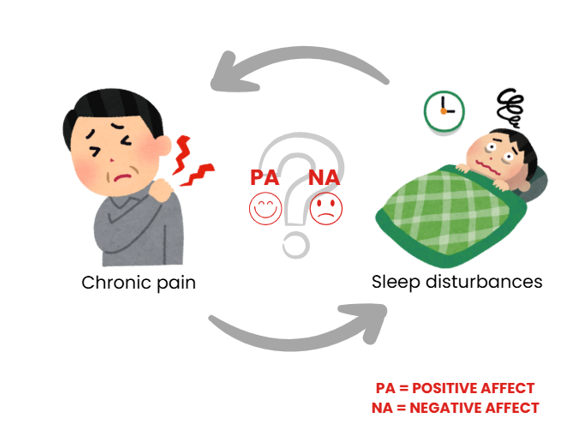
Do we not all experience a poor night of sleep sometimes? Importantly, this can impact our mood and even our pain perception the next day, which is especially relevant in persons with chronic pain.
Chronic pain, defined as pain persisting or recurring for more than three months, affects millions of people worldwide and reflects one of the leading causes of years lived with disability. Remarkably, chronic pain is commonly associated with sleep disturbances, with poor sleep consistently linked to greater daily pain. However, the sleep-pain link is known to be multifactorial and thereby influenced by a variety of factors in a person’s daily life. Among these factors, affect emerged as a potential contributor to this association.
How affect may interact with sleep and pain on a day-to-day basis
In modern science, the term “affect”, has been defined as a state of pleasure or displeasure with some degree of arousal. Negative affect comprises negative emotional feelings such as anger, fear and guilt, whereas positive affect encompasses positive emotional feelings such as optimism, enthusiasm and alertness. Since pain is a subjective personal experience, it is well-established that it can be modulated by both positive and negative affective states. This aligns closely with the fact that chronic pain should be approached from a biopsychosocial view, meaning that the experience of pain is shaped by a dynamic interplay between biological, psychological and social factors, all of which can be influenced in a bidirectional way. Pain is thereby an experience associated with many daily life experiences, behaviors, and events, making it likely to vary widely both within and across days in an individual. Likewise, because sleep is not something we can fully control, it can vary from day to day, especially in people who experienced sleep problems for a long time.
The Experience Sampling Method as a promising tool
A research method that can help us understand these within-person, day-to-day associations between sleep, pain and affect is the Experience Sampling Method (ESM). Rather than asking people to look back over weeks or months and describe how they generally felt (e.g., questionnaires), ESM can provide a more realistic picture of daily life. This is important because our memory is not always accurate when we are asked to recall past experiences. ESM is a self-report method that is designed to capture an individual’s experiences and/or behaviors across multiple time points over a defined period and is gaining increasing attention within the field of (chronic) pain research.
To what extent do positive and negative affect influence the sleep-pain link?
By reviewing the existing ESM literature, we found that affect may partially explain sleep-related fluctuations in chronic pain on a day-to-day basis. Positive affect might have a promising protecting role and can weaken the effect of poor sleep on next-day pain. However, the number of studies involved within our review was too small and heterogenous to draw any definitive conclusions. Therefore, this review highlights 1) the large knowledge gap that currently exists on this topic and 2) the strong need for standardized ESM procedures to enhance the comparability of studies using this method in the field of chronic pain research.
Luka Mattelin
Pain in motion PhD researcher focussing on the (day-to-day) sleep-pain link.
2026 Pain in Motion
References and further reading: