The link between stress and pain in chronic pain
Stress and pain are related to each other. My research team and I investigated the relationship between stress and pain in patients with chronic primary pain with a systematic review and meta-analysis, and the literature indicates that higher pain sensitivity is associated with higher blood pressure, higher heart rate and higher cortisol levels, and lower heart rate variability1. Furthermore, evidence suggests that stress system functioning may differ between patients with chronic pain and pain-free controls, although further research is needed to better understand the factors contributing to these differences2.
More information concerning this topic can be retrieved in an earlier blogpost: https://paininmotion.be/blog/detail/influence-chronic-stress-cortisol-levels-and-its-association-chronic-pain
Pain and stress are adaptive and protective mechanisms
Both pain and stress are adaptive and protective mechanisms designed to keep us safe. Pain warns us of harm and prevents/limits (further) damage, and when we encounter a (potential) threat or stressful situation, our major stress systems become activated: the autonomic nervous system (ANS) ands the hypothalamic- pituitary-adrenas (HPA) axis. The ANS generates a rapid stress response through the release of catecholamines, resulting in physiological changes such as increased heart rate and blood pressure. Also, enzyme levels of salivary alpha-amylase, which is a biomarker of stress, increases. These adaptations enable us to respond quickly. The HPA axis generates a slower but longer lasting stress response through the release of cortisol, which helps the body adapt to the stressful situation by mobilizing energy resources, regulating immune and inflammatory responses, and supporting the restoration of homeostasis.
Acute stress and pain responses are highly idiosyncratic
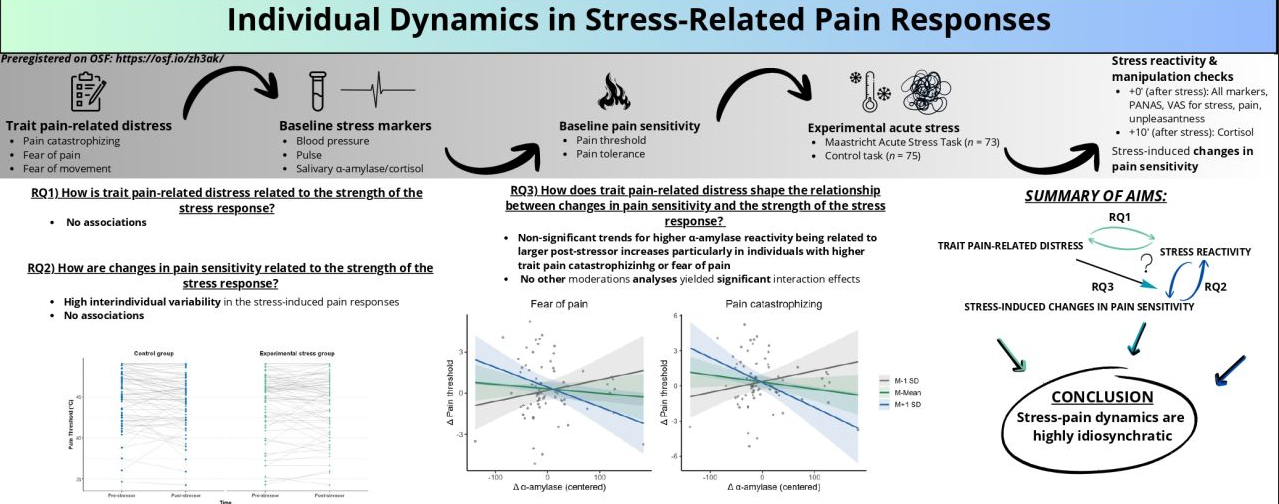
Acute stress can influence sensitivity to pain. For example, when pain sensitivity is assessed using standardized methods, such as pressure pain thresholds, before and after exposure to an acute stressor, studies have shown varying responses: pain sensitivity may increase, decrease, or remain unchanged. The literature suggests that the relationship between acute stress and pain responses is complex and characterized by substantial interindividual variability. There is limited evidence that distress factors related to pain (fear of pain, pain catastrophizing, kinesiophobia) may influence this relationship, although further research is needed. Therefore, a recent study by my research team and I investigated the link between stress reactivity and stress-induced changes in pain sensitivity, and investigated the moderating role of trait pain-related distress in this relationship3. With this study, we found that there is a high individual variability in how acute stress alters the stress-induced pain sensitivity, and trends emerged suggesting that in individuals with a higher tendency to catastrophize pain or higher fear of pain, larger alpha-amylase increases may be associated with larger post-stressor increases in pain threshold, which is indicative of lower pain sensitivity.
Summary: Can the way we think and feel about pain shape the stress-pain relationship?
Our study suggests that the way we think and feel about pain can shape the relationship between stress and pain responses. However, this should be interpreted cautiously since only non-significant trend-level effects emerged. Further research on stress-pain interactions should focus on the individual level to unravel moderating factors.
Joren Vyverman
Predoctoral researcher at Ghent University and Tilburg University investigating the interaction between stress and pain
2026Pain in Motion
References and further reading:
1Vyverman, J., De Baere, R., Timmers, I., Coppieters, I., Van Oosterwijck, J., & Moerkerke, M. (2026). The stress–pain connection in chronic primary pain: A systematic review and meta-analysis of physiological stress markers in relation to experimental pain responses. Neuroscience & Biobehavioral Reviews, 184, 106604.
2Woda, A., Picard, P., & Dutheil, F. (2016). Dysfunctional stress responses in chronic pain. Psychoneuroendocrinology, 71, 127-135.
3Vyverman, J., Timmers, I., Meeuwis, S. H., Smeets, T., & Hilger, K. (2026). Individual Dynamics in Stress-Related Pain Responses. Psychoneuroendocrinology, 107974.